




Do you really need a MES?
May 20, 2025
Deceiving ourselves with OEE
December 9, 2025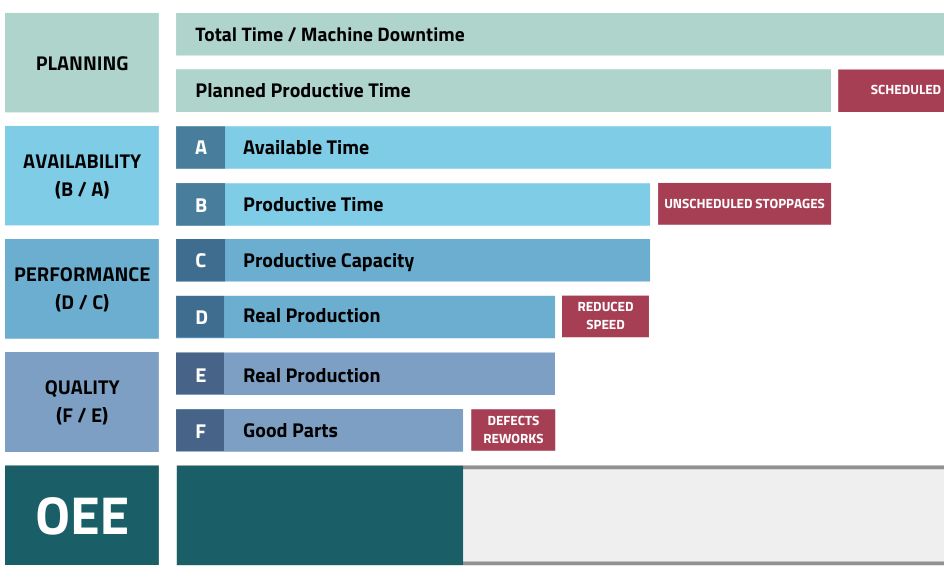
How to Calculate OEE Accurately – The Definitive Guide
Everyone in the industry knows (or claims to know) what OEE (Overall Equipment Effectiveness) is, and it is true that most of us start off on the right track when it comes to defining it. It is a measure of efficiency, as its name suggests.
But… How do we calculate it?
This is where you will not find two people who calculate OEE in the same way: some people only consider time, others simplify the indicator to make it easier to calculate, production plants discount frequencies from the target, etc.
Although we will see how to calculate OEE, it is important to understand that it does not matter if you calculate it differently. The important thing is that it is an efficiency indicator and that it allows us to see if we are improving or worsening.
I would even go so far as to say that OEE is not always the best productivity KPI. If you want to know more about plant KPIs, check out our post on Industrial KPIs.
✍️ In today’s article, we will discuss:
- What OEE is
- How to calculate OEE
- Availability, Performance, and Quality
- Recommendations
What is OEE?
OEE (Overall Equipment Effectiveness) is the indicator that measures the overall effectiveness of equipment, i.e. it measures the percentage of time that we are actually productive out of the total planned production time.
This indicator is one of the most important KPIs when it comes to controlling, identifying and correcting possible inefficiencies in our production line, as it allows us to detect areas for improvement in performance and equipment utilization.
More specifically, by analyzing OEE and its components (availability, performance and quality), we can identify the sources and causes of productivity losses, such as breakdowns, set-up time, speed loss, NOK parts or rework.
It is possible to calculate OEE for several machines, lines or even the entire plant. By collecting and analyzing this OEE in aggregate form, we will be able to more easily identify bottlenecks, optimize resource utilization and improve overall production efficiency.
We will also be able to compare OEE between different machines, processes, products or time periods, and thus see how it affects overall productivity and performance. This will allow us to identify opportunities for improvement and optimize our production system.

When calculated correctly, OEE will give us valuable insight into our operations, allowing us to recognize both our strengths and weaknesses. And the reality is that most industrial plants are far from perfect.
As a reference, real OEE values are approximately:

How to calculate OEE in general terms
OEE is calculated as a percentage, with an OEE of 100% equating to perfect production, with all parts perfect (no NOK) and no downtime of any kind (no stoppages due to breakdowns, micro-stoppages, unscheduled maintenance, etc.) and producing everything at the machine’s cycle time.
OEE is calculated based on three components: availability, performance and quality.
Thus, the calculation of OEE is generally defined by:
🧪 OEE (%)= Availability x Performance x Quality
Availability, Performance and Quality
Availability
Availability allows us to know how long a machine is operational compared to the total planned time. It is essential for identifying how much disruptions affect overall performance.

Formula:
🧪 Availability (%) = Operating Time (without unplanned downtime) / Total Planned Time
Total Planned Time refers to how long the machine will theoretically be producing. It is therefore the time we will be working, excluding any scheduled or planned downtime.
✏️ Example: We are going to work on our machine 2 for an 8-hour shift (480 minutes). But we know that there are the following planned stoppages:
- Shift Start Time = 5 minutes
- Final Cleaning Time = 15 minutes
- Breaks = 30 minutes
In total: 5 + 15 + 30 = 50 minutes of planned downtime.
Therefore, our Total Planned Time would be: 480 – 50 = 430 minutes
Operating Time or Productive Time is the actual time that the machine is producing. Therefore, we also have to deduct all unplanned downtime (due to breakdowns, delays, etc.).
✏️ Example: in our previous example, let’s assume that during that shift there was a breakdown that stopped the line for 50 minutes. This is an unplanned stoppage and we were expecting to be producing, so there is a loss of availability.
- Operating Time = 430 – 50 = 380 minutes
- Total Planned Time = 430 minutes
👉 Availability = 380/430 = 0.8837 = 88.37%
Performance
This indicator is responsible for evaluating our actual production rate against the expected theoretical rate. It will be determined by anything that slows down our manufacturing process (including slow cycles).
Note: We must not confuse this with other concepts. In different sectors, such as food, the term performance is used as an indicator of raw material utilization.

Formula:
🧪 Perormance (%) = Real Production / Productive Capacity
Real Production refers to the number of pieces (applies equally to kilograms or metres) that have actually been produced. Productive Capacity, on the other hand, refers to the theoretical number of pieces that should have been produced.
⚙ Real Production = No. Pieces Manufactured (OK + NOK)
Productive Capacity is also known as Theoretical Production.
⚙ Productive Capacity = Operating Time / Theoretical Cycle Time
The Theoretical Cycle Time or Ideal Cycle is the stipulated time at which we are able to produce when everything is working perfectly. It is usually determined by the maximum speed of the machine/line, or by the maximum speed of our process.
✏️ Example: Let’s assume that in our example, our machine has a theoretical cycle time of 1 minute. This means that when everything is working properly, its work rate is 1 piece per minute. However, at the end of the shift (380 operating minutes), we have only produced 320 pieces.
- Real Production = 320 pieces
- Theoretical Production = 380 minutes / 1 minute per piece = 380 pieces
👉 Performance = 320/380 = 0,842 = 84,2%
This means that in this shift, which had 380 operating minutes (this is the time excluding downtime), we should have produced 380 pieces, but due to inefficiencies, we were only able to produce 320. Therefore, we had a loss in performance.
Quality
This KPI considers manufactured parts that do not meet quality standards (including those that need rework).

Formula:
🧪 Quality (%) = OK Parts (excluding defective parts and rework) / Total Parts Produced
The Total of Parts Produced will be defined as the sum of all parts produced, including OK + NOK
✏️ Example: Let’s assume in our example that of the 320 pieces manufactured, 30 were defective in the process.
- OK Parts= 320 – 30 = 290
👉 Quality = 290 / 320 = 0,906 = 90,6%
OEE in practice ✏️
Following our example, we already have the efficiency losses we have had due to Availability, Performance and Quality. So, we just need to multiply each of them to obtain the OEE result.
Formula:
🧪 OEE (%) = Availability x Performance x Quality
👉 OEE = 88,37% x 84,2% x 90,6% = 0,8837 x 0,842 x 0,906 = 0,6741 = 67,41%
In conclusion, what we find is that of the time we planned to produce, only 67.41% was used to produce OK parts. The rest of the time was lost efficiency due to availability (breakdowns, unplanned downtime), performance (slow cycles, waiting times) or quality (time spent producing NOK parts).
Recommendations
It is important to view OEE not only as a one-off indicator, but as a tool for continuous improvement. OEE is not a static measurement, but a dynamic KPI that requires continuous data collection, analysis and action based on that analysis.
Thanks to OEE, we will know how well we are applying the principles and practices of process improvement in our production system. By tracking OEE as a tool for continuous improvement, we will be able to evaluate the impact of our improvement actions on production and also see how they affect OEE and its components over time.

Although OEE is a very valuable metric, there are other metrics that are equally or even more interesting, such as TEEP (Total Equipment Effectiveness Potential) and OOE (Overall Operational Efficiency), which will give us a more complete picture of your production performance.
Finally, we must not forget what we mentioned at the beginning of this post: the measure of efficiency is variable and personal to each company. You may use the classic OEE, you may calculate it differently, or it may not even be called OEE.
All of these options are good and perfectly valid. The important thing is to keep close track of our efficiency, which is essential in modern industry.
Want to learn more about how to calculate the efficiency of your plant 👇?

CTO & TECHNICAL DIRECTOR
Expert in industrial monitoring and data analytics.
We tell you how to improve decision-making and production efficiency in your plant, without wasting time generating reports. Your plant at a glance!
Subscribe to our Newsletter


